A good Janmashtami wish pairs a warm blessing with a personal sentiment suited to the person receiving it. It can help you share love with family and friends on this special occasion. Janmashtami marks the birth of Lord Krishna, and Ashtami Tithi means the eighth lunar day in a lunar fortnight.
In India, the 2026 observance fell on September 4, 2026, so that date has passed. Family customs differ, and one household’s way of celebrating may not match another’s. Your greeting can still share the same spirit of care.
Here you’ll find messages for different recipients, short captions, Hindi greetings, and scripture-based inspiration. A thoughtful blessing should sound like you, not like a formal announcement. For a message that feels personal, name the quality you most hope the recipient experiences, such as peace, joy, or courage.
Janmashtami Wishes for Family and Friends
For a close relative or friend, a simple blessing feels more personal when it names the happiness or peace you hope they find. One small detail can make familiar words feel like they belong to the person receiving them.
Choose a greeting that suits your relationship, then add a personal touch. A note about a shared meal or a friend’s kindness can turn a familiar blessing into a message they remember.
For parents and the whole family
Use a gentle, respectful tone for parents and elders. For a sibling, you can sound more playful or mention a family memory.
- May Lord Krishna fill your home with love, your heart with peace and your life with countless reasons to smile.
- May the divine blessings of Lord Krishna bring peace to your mind, joy to your heart and prosperity to your home.
- May your home be filled with joy, blessings, and divine charm. Happy Janmashtami!
- Thinking of our family time together and wishing you a day filled with Krishna’s love and blessings.
A greeting feels personal when its words fit the relationship, not just the occasion.
Cards and direct messages both suit these wishes. For a card, add a handwritten memory beneath the greeting; a short message works well in a chat.
For friends and loved ones
Krishna and Sudama’s story can inspire a friendship greeting, though every friendship has its own shape. Keep the reference warm and simple.
- May Lord Krishna’s blessings bring joy, peace, and laughter to your life. Happy Janmashtami, my friend!
Before sending a group greeting, change its opening so it feels addressed to the people in that group.
A short greeting works best when its blessing remains clear at a glance. Keep the message brief for a WhatsApp status, social post, or image caption.
A few clear words are easier to read and share than a long message. WhatsApp, Instagram, and Facebook all work well for greetings and captions.
Short wishes for WhatsApp
These short wishes fit a status or direct message. You can send one on its own or add a recipient’s name.
- Happy Krishna Janmashtami!
- May Lord Krishna bless you with wisdom, patience, and protection.
- Wishing you a Janmashtami filled with joy and peace.
- May Krishna bring hope and happiness to your life.
- Jai Shri Krishna! May your day shine with love.
Image-ready captions in English
English text can sit over a festive image, while the caption carries a longer sentiment. Try a short blessing with one clear visual idea.
- “May peace fill your day.” Pair it with a close view of a flute.
- “Wishing you Krishna’s blessings.” Add a peacock feather against a plain background.
- “May joy find a place in your home.” Show a lit diya near a doorway.
- “Happy Janmashtami!” Use a photo of simple festive decorations at home.
For Janmashtami wishes images for WhatsApp or English quote images, keep the words brief, use strong contrast, and leave clear space around the text. Avoid small, low-contrast lettering over a busy image. Check that the lettering is legible on a phone screen before sharing the image.
How Do You Wish Someone a Happy Janmashtami?
A heartfelt Janmashtami greeting needs only a name or devotional address, one sincere blessing, and a warm sign-off. Keep it natural for the person and the moment.
Use three parts: address the person or invoke Lord Krishna, add a blessing, then close with “Happy Krishna Janmashtami!” For example, you might address a friend by name, wish them peace, and sign off with the festival greeting.
You can address Lord Krishna devotionally as Kanha or Bal Gopal. A birthday wish for the deity is better framed as a respectful salutation, not as a note to a human recipient.
For a stylish English greeting or image, use one short blessing with a devotional sign-off. A wish expresses hope; it cannot promise wealth, success, or any other outcome.
Messages such as “May Lord Krishna guide your path” or “May Lord bring peace to your heart” keep the tone warm. When sending warm wishes, choose words that feel right for the occasion and your relationship. Read the line aloud once to check that it sounds natural for the person who will receive it.
What Janmashtami Celebrates in Simple Words
In simple words, Janmashtami is the Hindu festival celebrating the birth of Lord Krishna. His birth holds deep meaning in Hindu tradition, where he is revered as the eighth incarnation of Lord Vishnu.
The festival follows a lunar date, so its Gregorian date shifts from year to year. Ashtami Tithi is the eighth lunar day of a fortnight, and Janmashtami falls on that day in the dark fortnight of Bhādrapada.
Bhādrapada usually falls in August or September on the Gregorian calendar. The date can change because the lunar calendar does not match the fixed days of the Gregorian calendar.
Janmashtami is also known by several regional names. These include Krishnashtami, Gokulashtami, Ashtami Rohini, Srikrishna Jayanti, and Sree Jayanthi.
In a well-known birth story, Vasudeva carries the infant Krishna across the Yamuna River to Gokul. The story is told in different ways across traditions, so not every detail is shared by all communities.
The name Krishna Janmashtami points to the birth the festival honors. For many people, the day is also a time to reflect on faith and Lord Krishna’s place in their lives. Remember that the festival’s Gregorian date shifts because its observance follows the lunar calendar.
Janmashtami Wishes in Hindi
A Hindi greeting can feel especially warm when it uses words the recipient knows and enjoys. Choose a familiar style so the message feels easy to read and share.
Use Devanagari or Roman letters based on what your recipient can read comfortably. The Hindi name for the festival is जन्माष्टमी, pronounced “ja-nmashtah-mee.”
Hindi greetings in Devanagari
These complete greetings suit a card, chat, or family message. You can copy one as written.
- श्री कृष्ण आपके जीवन में सुख, शांति और समृद्धि लाएं। जन्माष्टमी की हार्दिक शुभकामनाएं।
- कान्हा की कृपा आपके परिवार पर हमेशा बनी रहे। जन्माष्टमी की शुभकामनाएं।
- आपको और आपके परिवार को जन्माष्टमी की हार्दिक शुभकामनाएं।
- श्री कृष्ण आपके जीवन में प्रेम, आनंद और शांति भर दें।
- कान्हा का आशीर्वाद आपके घर में सुख और खुशियां लाए।
Simple Romanized greetings
Roman letters can be easier to type when your keyboard is not set up for Hindi. Spelling can vary between transliterations, so these are useful versions rather than the only correct forms.
- Shri Krishna Janmashtami ki hardik shubhkamnaye.
- Janmashtami ki shubhkamnaye.
- May Kanha bless you with happiness and peace.
- Jai Shri Krishna, aapko Janmashtami ki shubhkamnaye.
You may also see Jai Shri Krishna in a short greeting, or a wish that Shri Krishna bring blessings to someone’s home. Match the script to the person receiving the message, then check the spelling before sending.
Bhagavad Gita Quotes for Janmashtami
A widely useful Krishna quote for Janmashtami is Bhagavad Gita 2.47, with its focus on action rather than attachment to results. It speaks to daily effort without asking you to give up hope.
Choose a verse for the idea you want to share, and keep its reference with the quote. The Bhagavad Gita offers thoughts on both action and the return of dharma.
A verse on action and its results
Bhagavad Gita 2.47 says:
- “You have a claim on action alone, never on its fruits. Do not let the fruits of action be your motive—and do not be attached to inaction either.”
The verse encourages action without making results your only reason to act. Bhagavad Gita 2.48 adds that yoga means acting without attachment and staying even-minded in success and failure.
Krishna’s teaching on restoring dharma
In Bhagavad Gita 4.7–8, Krishna says he appears age after age when dharma declines and adharma rises. He comes to protect the good, destroy wrongdoers, and establish dharma.
If someone asks for Krishna’s best line, 2.47 is one widely useful choice, not an objectively ranked answer. Its message can offer strength and courage when you face a hard path.
These original reflections may suit a card, but they are not scripture:
- Let steady effort guide you, even when the outcome is unclear.
- May Krishna’s wisdom bring hope to the choices ahead.
- May your faith give you peace as you follow a kind path.
Keep quotation marks and the verse reference for scripture, and leave them off original greetings.
How Families Celebrate Janmashtami at Home and Across India
Janmashtami celebrations may bring together prayer, family traditions, and a midnight observance. Each home shapes the day in a way that fits its faith and local customs.
Fasting, bhajans, temple visits, and midnight prayer are common observances, not rules for every household. Some families worship an image of baby Krishna at midnight.
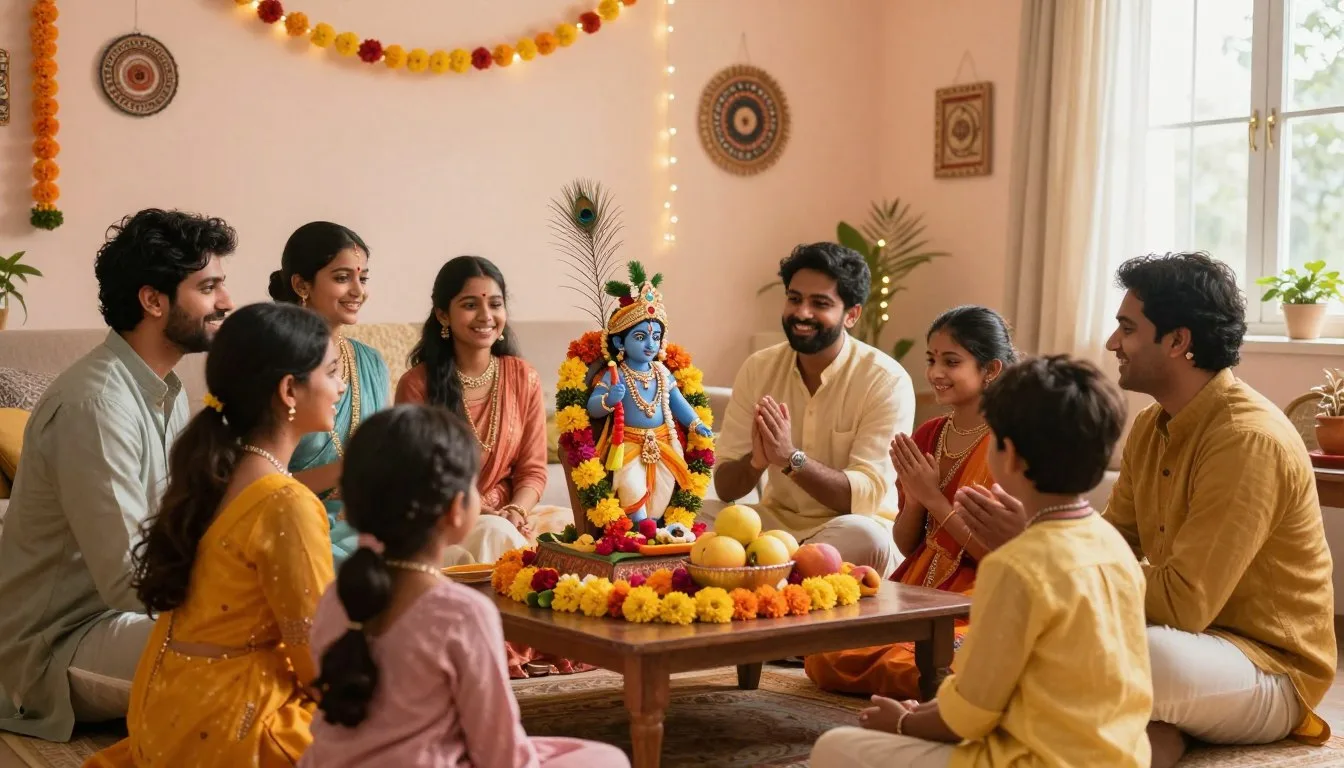
At home, relatives may place a Bal Gopal image in a cradle, prepare festive food, or dress children as Krishna or Radha. Other families may visit a temple or spend the evening singing bhajans.
A midnight prayer is one possible observance, not a requirement for every home.
Public events also reflect local traditions. Mathura and Vrindavan are linked with Krishna’s childhood, while Dwarka is an important pilgrimage destination.
Mumbai is known for Dahi Handi celebrations. In Maharashtra and Goa, Dahi Handi takes place on the day after Krishna Janmashtami.
These regional customs add their own character to the day, while families make choices that suit their beliefs and needs. Follow the practices of your household and local community rather than assuming every region celebrates in the same way.
Conclusion
The most memorable Janmashtami greeting is one that carries a sincere blessing and a personal touch. A few warm words can help loved ones feel close, whether they celebrate beside you or far away.
You do not need a long message to share the spirit of the festival. Mention a quality you value in the person, or add a detail that belongs to your bond.
Choose one line that feels true to you, add the recipient’s name, and share it with a loved one.