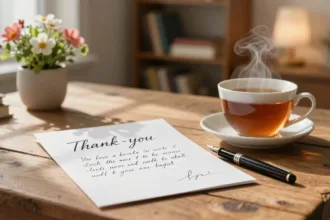
A heartfelt thank-you message names what someone did and why it mattered to you. These Thank You Messages can help you thank a friend or relative for a gift, an act of kindness, shared time, or steady support.
You do not need a grand speech to show gratitude. A few honest words can tell someone their care made your life brighter, especially when you point to a moment they remember too. The examples here can suit a close friend, a parent, a sibling, or another family member. Adapt the wording to fit your relationship and the gesture you want to recognize.
A personal detail is a specific action, gift, memory, or effect that makes a thank-you message feel written for its recipient. You might mention a meal someone brought, a late-night talk, or how their help eased a hard day. You can keep the rest of your note simple. A small personal detail can make even a short note feel unmistakably yours.
What Are Some Short Ways to Say Thank You?
“Thank you for making today feel a little brighter” works when you want a message that is brief but personal. Short words to say thank you and show appreciation can feel warm when they name the recipient or the gesture. A few specific words often feel more sincere than a long, general note.
Use these short thank-you messages in a card, text, or caption. Each line can stand alone, or you can add a name or one detail about what happened.
- “I appreciate your kindness more than you know.” “Your thoughtfulness made my day.”
- “Thanks for being there when I needed you.” “I’m grateful for the time you gave me.”
- “Thank you for making an ordinary day feel special.” “Your help meant so much to me.”
- “I appreciate the care you put into this.” “Thank you for always making room for me.”
- “Your kind words stayed with me all day.” “I can’t thank you enough for showing up.”
A brief thank-you feels personal when it names the recipient or the gesture.
For fresh appreciation thank-you quotes, choose a simple line that sounds like something you would say aloud. A card might call for a little more warmth, while a text can stay quick. These short thank-you quotes are original, so you can use them without attaching a famous name.
To say thanks in a unique way, describe the effect rather than reaching for fancy words. “You made the long wait easier” says more than “You’re amazing.” If you want to thank someone very much, write what their kindness changed for you. Use the recipient’s name when a very short note might otherwise feel impersonal.
Thank You Messages for Friends and Family
“You have been the person I can laugh with and lean on, and I feel lucky to have you in my life.” A close friend or relative may value a message that reflects your real bond, not a polished speech. Honest warmth matters more than grand wording.
Name a shared moment or a kind action to make the message feel true to your relationship. These examples focus on care and companionship, without assuming every family tie feels easy.
For a friend who shows up
- “You make me laugh even on the days I need it most.” “I love that we can pick up right where we left off.”
- “Thank you for listening without trying to fix everything.” “Your encouragement helped me trust myself again.”
- “I feel lucky to have a friend who shows up, every time.” “You made that hard week easier just by being there.”
- “Our old stories still make me smile.” “I appreciate how you check in, even when life gets busy.”
For parents, siblings, and relatives
- “Thank you for the care you have shown me through the years.” “Your advice helped me find my own way.”
- “I’m grateful for the family traditions you keep alive.” “You stood beside me when things felt uncertain.”
- “Thank you for making space for me, even when we see things differently.” “Your steady care has meant a lot.”
- “You’re family, and you also feel like a friend I can count on.” “I value the time we get to share.”
A note can recognize love without claiming a relationship is perfect. If you are still finding your footing with a relative, thank them for one thing they did, such as calling or offering a ride. That keeps your words sincere and lets the recipient understand what mattered.
Some relatives show care through small routines, like saving you a seat or sending home leftovers. Naming that detail can make an everyday note feel personal. Choose a message that reflects the relationship as it is, rather than forcing a level of closeness that does not fit.
How Do You Thank Someone for a Gift?
“Thank you for the cookbook; I can’t wait to try the recipes you marked for me.” Name the gift or how you plan to use it, so the recipient knows you noticed the thought behind it. A useful detail makes a gift message feel specific.
For money, focus on your gratitude and a possible purpose, not the amount. These examples cover presents, gift cards, and cash without sounding like a receipt.
- “Thank you for the soft blanket; it has already become my favorite.” “The book you chose is exactly my kind of story.”
- “Thank you for the gift card; I’m saving it for a new pair of walking shoes.” “Your surprise gift made me smile all afternoon.”
- “Thank you for the money. I’m putting it toward the class I have wanted to take.” “Your generous gift will help with my next home project.”
- “I can’t wait to use the serving bowl at our next family dinner.” “Thank you for choosing something I’ll use every day.”
- “Your gift was such a kind surprise.” “Thank you for thinking of me and choosing something so useful.”
A note can mention a physical present, a gift card, or money without making the message formal. If you plan to use a gift soon, say how: a scarf for a trip, a pan for weekend cooking, or a gift card for a needed item. You can also thank someone for their generosity without naming a specific use.
Some gifts may not fit your needs or taste. You can still acknowledge the thought behind them without pretending to love the item. For example, “Thank you for thinking of me and taking the time to choose a gift.” That thanks the giver without making a false claim.
A simple, clear note is enough when you have little to say beyond your gratitude. For a gift that is not a good fit, thank the giver for thinking of you rather than making a false claim about the item.
What Should You Say About Birthday Wishes?
“Your birthday wishes made my day feel extra special, and I’m grateful you thought of me.” Clear birthday thank-you messages can mention a warm wish, a call, a card, or time spent celebrating. A personal reply lets the recipient know their greeting reached you.
For a group post, thank everyone together and add one detail about the day. Use these lines for a one-to-one text, a card, or a reply to a group.
- “Thank you for the lovely birthday message. It made me smile.” “Your call was such a kind way to start my day.”
- “I’m grateful you remembered my birthday and took the time to write.” “Your card was a lovely surprise.”
- “Thank you for making time to celebrate with me.” “Your warm wishes made my special day feel even brighter.”
- “I’m late replying, but I truly appreciated your birthday message.” “Thanks for thinking of me and making me feel celebrated.”
- “Thank you, everyone, for the kind birthday wishes. Dinner with you all was the best part.” “Your messages made my birthday feel full of care.”
Natural English can be simple: “Thank you for the birthday wishes. I’m glad you thought of me.” For someone who called, mention the conversation; for someone who sent a card, name the card. You do not need a different style for every greeting.
A belated reply can still sound warm if you acknowledge the delay briefly and focus on the person’s message. You might say, “I’m sorry this reply is late, but your birthday wishes meant a lot.” A group post works well when many people sent greetings at once.
Choose one detail that fits the moment, such as a shared meal or a funny birthday story. For a group reply, thank everyone together and add one detail about what made the day memorable.
How Do You Thank Someone for Support or Help?
“You stepped in when I was overwhelmed, and your help made a real difference.” A strong message for support or help names the action and what changed because of it. That effect can be practical or emotional.
When someone’s suggestion helped, say what it helped you see or do. The examples below cover practical assistance, encouragement, listening, and showing up.
- “Thank you for helping me carry everything upstairs. I could not have managed alone.” “Your quick help gave me room to catch my breath.”
- “Your words helped me keep going when I wanted to quit.” “Your advice gave me a clearer way to handle the problem.”
- “Thank you for listening without rushing me.” “You made a difference simply by letting me talk.”
- “You showed up when I needed someone beside me.” “Your steady support made a hard week feel less lonely.”
- “Thank you for helping at such short notice. You saved me a lot of stress.” “I appreciate that you changed your plans to help me.”
A message can name help with a task, a ride, a meal, or a last-minute change. For ongoing support, say which part has mattered most, such as regular check-ins or patient listening. That helps the recipient see the impact of what they did.
Short quote-style lines work well in a card or text when you want to keep the tone direct. “Your support helped me find my footing” is warm without adding extra claims. You can also thank someone for a suggestion by naming the next step it made possible.
Help offered at short notice deserves a clear mention of the time pressure. You might say their quick response gave you a way forward. Name the action that helped instead of relying on a general line about being grateful.
What Can You Say for a Kind Act or a Welcoming Visit?
“Your warm welcome and the dinner you made helped us feel at home.” Thank someone for kindness by naming the gesture, the visit, or the practical favor that made you feel cared for. One clear moment gives your words warmth.
A specific detail, such as a meal or a pet’s routine, shows what you appreciated. These lines cover a kind act, hospitality, and pet-sitting.
- “Thank you for clearing the snow from our steps. It made getting out much easier.” “Your neighborly kindness saved me a trip to the store.”
- “Thank you for checking on me and bringing soup. The warm meal was just what I needed.” “Your thoughtful note lifted my mood.”
- “Your comfortable guest room made our visit restful.” “I loved talking with you on the porch after dinner.”
- “Thank you for welcoming us so warmly. The meal brought everyone together.” “We felt at home from the moment we arrived.”
- “Thank you for caring for my cat and keeping to her feeding routine.” “Knowing the dog was happy and safe gave me peace of mind.”
Hospitality can mean a spare bed, a homemade meal, or making time to sit and talk. Mention one thing you enjoyed, such as a favorite dish or an evening conversation. That shared moment can make a host feel seen.
Practical kindness deserves thanks too. A neighbor who takes in a parcel or clears a path may have saved you time and worry. For pet-sitting, a detail about your animal’s routine shows you noticed the care involved.
Keep the message tied to what actually happened instead of praising a visit in broad terms. Mention one thing you especially enjoyed rather than praising every part of a visit in generic terms.
Which Messages Fit Weddings, Graduations, and Other Milestones?
Milestone messages work best when they thank someone for being present, traveling, giving, or offering support. “Having you beside us on our wedding day made the celebration feel complete.” A shared milestone gives you a natural detail to mention.
Say what the recipient did and how it shaped the day or next chapter. These examples suit one person or a couple, from a wedding to a new home.
Weddings and new beginnings
- “Having you with us on our wedding day meant more than you know.” “Your presence mattered more to us than any present.”
- “Thank you for traveling so far to celebrate with us.” “Your support helped us enjoy every part of the day.”
- “We love the serving set you gave us and will use it for family dinners.” “Your wedding gift will be part of our new home.”
Graduation, baby showers, and family milestones
- “Thank you for cheering me on at graduation. I’ll remember seeing you there.” “Your kind words helped me feel proud of how far I’ve come.”
- “Thank you for celebrating our growing family at the baby shower.” “Your care made this new chapter feel even more joyful.”
- “I’m grateful you marked our anniversary with us.” “Thank you for helping us settle into our new home.”
A wedding thank-you can recognize a guest’s presence, travel, support, or present. You can adapt “us” to “me” when writing to one person, or keep “we” for a couple. For a graduation, name the effort or achievement the person celebrated with you.
Baby showers, anniversaries, and new homes all mark a change in family life. A simple note can say how someone’s presence made the day feel more complete. If a gift will become part of your next chapter, mention the item or how you plan to use it.
A specific detail helps keep a milestone note from sounding like a form reply. If a present is mentioned, name it or say how it will become part of your next chapter.
How Can You Thank Someone at Work or in a Mentoring Role?
Thank a coworker, manager, or mentor by naming their contribution and its effect on your work. “Your suggestion gave our project a clearer direction, and I appreciate you sharing it.” Professional gratitude can sound warm without becoming too personal.
Be sincere and specific, but avoid promises or claims about a close bond. These examples cover team effort and professional guidance.
Coworkers and team members
- “Your clear updates helped us keep the project moving.” “I appreciate how reliably you followed through on each task.”
- “Your idea helped us solve the issue and improve the final plan.” “Thank you for the hard work you put into this project.”
Managers, mentors, and professional guidance
- “Your feedback helped me see how to strengthen my next draft.” “I appreciate the time you took to explain your approach.”
- “Your career guidance helped me think through my next step.” “Thank you for encouraging me to take on a new challenge.”
To thank someone for a great idea, you could write, “Your idea helped us simplify the process and finish with a clearer plan.” That line recognizes the idea’s contribution without overstating its impact. For a coworker, point to the task or project they helped move forward.
A manager may value a note that names useful feedback, time, or guidance. A mentor may appreciate hearing which part of their advice you used. Keep the focus on their effort and what it changed for you or the team.
A professional thank-you can fit in an email, a card, or a short message, depending on your usual work style. It need not sound like praise written for a public announcement. For a professional message, name the contribution and its effect without assuming a personal relationship.
What Can You Write to a Teacher or Coach?
“Your patience helped me understand the subject, and your encouragement made me believe I could improve.” Thank a teacher or coach by naming a lesson, skill, or moment that stayed with you. Specific praise makes the message feel earned.
Point to what the recipient helped you learn or build. These options work in a card or an end-of-season note.
- “Thank you for explaining the lesson in a way I could follow.” “Your patience helped me feel ready to ask questions.”
- “I appreciate the time you spent helping me improve my writing.” “Your feedback showed me what to work on next.”
- “Thank you for teaching me to stay calm under pressure.” “Your encouragement helped me keep practicing when the skill felt hard.”
- “You helped me build confidence on the field, one practice at a time.” “I’m grateful for the effort you put into every training session.”
- “Thank you for helping my child feel welcome and capable in class.” “Your kindness made a real difference to our family.”
- “I’ll remember the skill you taught me and the patience you showed.” “Thank you for making this season one I’ll look back on fondly.”
A teacher may remember a note that names one lesson, such as learning to revise a story or solve a math problem. A coach may appreciate a line about a skill that took practice. Both can hear what their guidance meant to you.
Parents can write on behalf of a child by naming a change they noticed, such as joining class with more confidence. An end-of-season message can also mention a moment when a coach offered support after a tough game. Keep the praise tied to what happened.
Even a short card can show gratitude when it points to a real part of the recipient’s work. Mention one lesson or skill the recipient helped build so the gratitude feels earned and specific.
How Do You Thank Someone During a Difficult Time?
“Your quiet check-ins gave me comfort when I did not have much energy for conversation.” During illness, grief, or personal hardship, a thank-you can recognize care without asking you to sound cheerful. A few honest words are enough.
You do not need a long note when your feelings are still raw. These examples mention food, check-ins, and staying present without suggesting that gratitude cancels grief.
- “Thank you for bringing dinner while I was ill. It gave me one less thing to worry about.” “Your check-ins helped me feel cared for during treatment.”
- “I’m grateful you sat with me after the loss. Your quiet company mattered.” “Thank you for remembering me when the days felt especially hard.”
- “Your kind message reached me when I was having a rough day.” “Thank you for offering help without asking me to explain everything.”
- “I may not have many words yet, but I appreciate your care.” “Thank you for staying close while I find my way through this.”
- “The food you left at my door helped more than I can say.” “Your calls let me talk when I was ready and stay quiet when I wasn’t.”
- “Thank you for being there through a hard stretch.” “Your steady care has made a difference, even when I could not say so.”
A message during grief can be brief and still mean a lot. You might thank someone for leaving food at the door, checking in, or simply staying near. There is no need to say that you feel better if you do not.
Illness can drain the energy needed to write a full note. A short text can name the practical help that made the day easier. For a personal hardship, thank the person for respecting your pace or offering a quiet place to talk.
Let your words match what you can honestly say right now. A simple, honest line is appropriate when a longer note would feel like too much.
When Does a Funny Thank-You Message Work?
“You helped me move every box, so I owe you at least one pizza and a very good back massage.” A funny thank-you works best with a close friend or relative who enjoys that kind of humor. Start with real thanks before the joke.
Use humor only when it fits the relationship and will not make the gesture seem small. If a joke could land badly, choose a sincere line instead.
- “Thank you for moving my whole room. I’ll repay you in pizza and snacks.” “You carried the sofa, so I hope you accept my eternal gratitude and a cold drink.”
- “You saved me with last-minute babysitting. My child has already asked when you’re coming back.” “Thanks for the help. I owe you one quiet afternoon.”
- “Thank you for bringing food. I was two minutes from calling cereal dinner.” “Your cooking was so good that I may invite myself over again.”
- “Thanks for listening to my story for the third time. You deserve a medal.” “You know our shared joke still makes my day.”
- “You helped me clean up after the party. I’ll pretend I was going to do it myself.” “Thanks for staying late; you’re now on the official snack team.”
- “I appreciate you fixing that mess. My future self would like to thank you too.” “You made a rough day lighter, and I’m still laughing about it.”
Lighthearted wording can suit a friend who helped you move or a relative who stepped in at the last minute. Keep the joke focused on the situation, not on the recipient’s effort. A small promise of pizza or snacks can add warmth when you mean it.
A heartfelt option is better when the gesture was serious or the person may not enjoy teasing. Try, “I’m truly grateful you made time to help me today.” That line recognizes their care without adding humor that could distract from it.
If you are unsure how the recipient will read the joke, keep the humor gentle and choose familiar words. Let the real thank-you stay clear even when the rest of the message is playful.
How Do You Write a Thoughtful Thank-You Note?
A thoughtful note works best when it names the gesture, explains its effect, and sounds like you. Start with a greeting, express thanks, and describe what the action meant. One real detail helps turn a general line into a personal message.
A useful note has six parts: greeting, thanks, impact, thoughtfulness, a future connection when fitting, and a warm sign-off. You can leave out a part when it does not suit the relationship.
Name the gesture and its effect
Begin with the recipient’s name or a greeting that fits your bond. Then thank them for the specific gesture: the ride, the meal, the advice, or the time they gave. “Thanks for bringing dinner” is clearer than “Thanks for everything.”
Next, say what the gesture changed for you. You might explain that the meal gave you time to rest, or that a call helped you feel less alone. A personal detail can show the recipient that you noticed their thoughtfulness.
Consider the care behind the act, too. A line such as “You remembered that I love lemon cake” recognizes the thought without adding a long story. The message can stay simple while still showing why their choice mattered.
Choose a format and finish warmly
A handwritten card can suit a meaningful gift or a major event, while a text can feel right for everyday help. A group post may work when many people took part in one celebration. Choose a format that fits the recipient and how you usually speak.
A simple structure could read: “Hi Maya, thank you for driving me to the appointment. Your help eased a stressful morning. I’m grateful you made time for me. With love, Sam.” Each sentence has a clear role, yet the note still sounds natural.
You can close with a warm sign-off such as “Take care,” “With love,” or your name. Add a future-facing line only when you genuinely expect or want to continue the connection.
What Should You Say When Someone Thanks You?
A simple “You’re welcome, I’m glad I could help” is warm without making the moment awkward. Choose words that fit the exchange, from a casual reply to a more formal response. Plain acceptance lets the recipient feel heard.
Accept the gratitude without brushing it aside or insisting your help was nothing. These replies offer easy options for different tones.
- “You’re welcome.” “Happy to help.”
- “My pleasure.” “Anytime.”
- “I’m glad it worked out.” “I was glad to be there.”
- “You’re very welcome.”
“You’re welcome” suits many everyday moments, while “My pleasure” can sound warmly formal. “Happy to help” works well between friends or coworkers. Your tone and the relationship can guide the choice.
If someone thanks you for help, a short reply is enough. You can say, “I’m glad it worked out,” or “I was glad to be there.” Those responses recognize the exchange without turning it into a speech.
Accept gratitude plainly instead of contradicting the person or insisting the gesture was nothing.
If someone praises your effort, try, “Thank you, I really appreciate that.” It accepts their words with humility instead of rejecting the kindness. A friend may prefer a casual reply, while a formal exchange may call for “You’re very welcome.”
Conclusion
The most meaningful thank-you is the one that sounds true to your relationship. A specific, honest message can help friends and family feel valued, whether you are recognizing a gift, a small act, or steady care.
You do not need to write a perfect note. Choose one example and adapt it with a real detail about what the recipient did or how it affected you. A sincere line can make a familiar moment feel seen.
Choose one person you appreciate, add the detail only you could know, and send your note today.