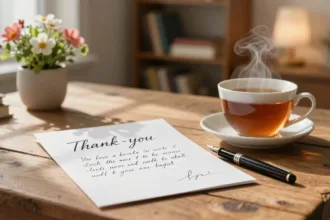
A short, sincere thank-you works best when it names what you appreciate and why it mattered to you. A few personal words can turn a quick reply into a sign of real care.
Thank You Messages can help you express everyday gratitude without sounding stiff or distant. You will find heartfelt words for gifts, birthday wishes, support, work, and everyday kindness.
Choose the example that sounds most like you, then make it personal with one true detail.
Short Thank-You Quotes for Everyday Appreciation
“Thanks for making today easier” is a simple line that names both the help and its effect. Specific words make even a short message feel warm and true.
Ten compact expressions can cover everyday, personal, and professional moments. Pick one that suits a text, card, or casual conversation.
Name the person’s effort or kindness, then say what it meant to you.
Use these short thank-you quotes when you want words to say thank you and appreciation without a long note.
- Thanks for making today easier.
- I appreciate the time you gave me.
- Your kindness meant a lot.
- Thanks for thinking of me.
- I’m grateful for your steady support.
- That was so thoughtful of you.
- Thanks for being there when I needed you.
- You made a busy day feel lighter.
- I appreciate how much care you put into this.
- Thanks for helping me get it done.
These thank messages range from casual to heartfelt, so you can choose a line that fits the recipient. “Thanks” can express gratitude or serve as a courteous, somewhat informal expression of gratitude.
When you want to express gratitude, an honest detail often says more than extra words. A quick “thank you” can feel complete when the moment is small, but a little more context can show why the gesture mattered.
For a message that feels more personal, swap a general word such as “help” for the exact thing the person did.
How to Write Thank You Messages That Feel Personal
A thoughtful thank-you note can follow six simple moves, from a warm greeting to a personal sign-off. Gratitude means the state of being grateful or thankful.
A thank-you note can be about four sentences long. Name the gift or act of kindness, then add a personal thought about what it means to you.
Build a thoughtful message in six moves
Start with the recipient’s name or a warm greeting. Name the action or gift clearly, so the person knows what you noticed.
Explain its impact on your day, plans, or feelings. Recognize the thought behind the gesture, such as the care it took to choose or offer it.
Add a future-facing line when it fits, like looking forward to seeing the person. Sign off warmly with your name or a familiar closing.
Write a thank-you note as soon as you can, while the details still feel fresh. A late note is better than no note, so send it even if time has passed.
Make a short note sound like you
Use one real detail instead of adding several general compliments. “I’ve already put the blue mug on my desk” sounds personal and stays brief.
A thank note should sound like something you would say aloud. Choose “I’m glad you were there” over formal words that feel unlike you.
Read the message once before sending and remove any line that does not add meaning. Before sending, check that the recipient can tell exactly what you appreciated.
Thank-You Messages for Gifts
A useful gift message names the present and gives the giver a personal reason you appreciate it. A real detail shows you noticed the thought behind the choice.
A gift deserves acknowledgment unless you opened it in front of the giver and thanked them in person. Mention how you plan to use or enjoy the present.
For a thoughtful present
For a new cookbook, you might say, “Thank you for the cookbook. I can’t wait to try the pasta recipes this weekend.”
For a soft blanket, try, “The blanket is perfect for my reading chair. I’ll think of you whenever I curl up with it.”
For money or a gift card
Thank the giver for their generosity and mention a possible use, without naming an amount. “Your gift card was so thoughtful; I’m saving it for a new pair of walking shoes.”
A cash gift can support a plan or make a busy month easier. Keep the focus on the giver’s care rather than the money itself.
These five messages work in a card or a short text:
- Thank you for the sketchbook. I’m excited to fill it with new ideas.
- The serving bowl is lovely, and it will be part of many family dinners.
- Your gift card was such a kind surprise. I’ll enjoy choosing something with it.
- Thank you for the book. Its subject is exactly what I’ve been curious about.
- I appreciate your thoughtful gift. It will make my new home feel more settled.
When you thank someone for cash, acknowledge the generosity without making the amount the focus.
Thank-You Messages for Birthday Wishes
A natural birthday reply can thank the person for remembering you and say how their wishes made your day feel. Warm and direct wording suits a quick reply.
You can send birthday thanks by card, text, social media post, or phone call. Mention the wishes or gift, say how they made you feel, and close warmly.
For birthday texts, calls, and cards
For one person, write, “Thank you for the birthday message. Your kind words made my special day brighter.”
For a group post, try, “Thank you all for the birthday wishes. I felt so loved reading your messages.” Keep the wording natural, not overly formal.
For a birthday gift or celebration
When thanking a gift-giver, name the present and share how you will enjoy it. When thanking someone who came to celebrate, mention their presence or the time they spent with you.
Here are five birthday messages for different moments:
- Thanks for remembering my birthday. Your message made me smile.
- Your call was a lovely surprise, and I’m glad we got to talk.
- Thank you for the beautiful scarf. I wore it on my birthday dinner.
- I loved celebrating with you. Thanks for making the evening so fun.
- Thank you all for the birthday wishes; they made the day feel special.
“Thank always” may sound unnatural in English; “Thank you for always remembering” is clearer and more natural.
For a group post, keep the thanks broad; for an individual reply, mention the person’s specific wish, gift, or effort.
Thank-You Messages for Friends
“I’m lucky to have you as a friend” works best when you follow it with one detail only that friend would recognize. A shared detail makes the line feel like yours.
Match the warmth of your message to the friendship you share. A close friend may welcome a nickname, while a newer friend may prefer a simple, friendly line.
For a close friend, try, “I love how you can make even a grocery run feel like an adventure.” It recognizes a quality you enjoy together.
For someone you know less well, write, “Thanks for being so welcoming at the book club. I’m glad we’ve had a chance to talk.”
A shared memory can bring a message to life: “I still laugh about the rainstorm that sent us running into that tiny café.” It points to a moment the two of you remember.
To recognize steady presence, say, “You’ve been a calm, familiar part of my life through so many changes.” This thanks a friend for consistency, not one particular act.
Choose words that sound right for your bond, rather than borrowing a phrase that feels too intense. Some friends enjoy big declarations; others prefer a short, funny note.
A message can mention a quality, a favorite moment, or a small habit that makes the friend special. “You always know which song belongs on a road trip” feels more personal than a broad compliment.
Use an inside joke only if it will make the recipient feel included and appreciated.
Thank-You Messages for Family and Loved Ones
“Thank you for making our family feel cared for” suits a loved one whose everyday effort often goes unmentioned. One clear example helps the message feel sincere.
Family messages can recognize ongoing care as well as one specific gesture. A parent, sibling, grandparent, or partner may call for a different level of warmth.
To a parent, write, “Thank you for checking in before my first day. Your steady care helps me feel ready.” This names a small, thoughtful act.
For a sibling, try, “I appreciate how you keep family plans organized. You make it easier for everyone to show up.” The message recognizes a distinct role.
To a grandparent, say, “Thank you for teaching me your bread recipe. I love having a way to carry that family tradition forward.”
For a partner, write, “I love the way you make room for my quiet evenings after a long week.” Romantic words belong where they feel true.
Not every family relationship feels close, and your message does not need to pretend otherwise. A simple “Thank you for calling and asking how I was” can be kind without overstating the bond.
For a loved one who handles many small tasks, you might say, “I notice all the ways you help our home run smoothly.” Acknowledging regular effort can mean a great deal.
Choose language that reflects the relationship you actually have, not the one a greeting card assumes.
Thank-You Messages for Support and Kindness
“You stepped in when I needed help, and it made a real difference” links the action to its effect. Clear thanks can honor both the effort and its result.
Name the kind of support and explain what it changed for you. Practical help, encouragement, and a listening ear each deserve their own words.
For practical help
For someone who shared a task, try, “Thank you for sorting the meeting notes with me. We finished the work before the deadline.”
For a person who stepped in at short notice, write, “I appreciate you covering my shift today. You helped me handle a family need.”
For emotional support
For someone who listened, say, “Thank you for letting me talk without trying to fix everything. I felt less alone afterward.”
For steady encouragement, write, “Your check-ins helped me keep going through a hard week. I’m grateful you stayed in touch.”
These five support messages name different kinds of help:
- Thanks for picking up the supplies when I couldn’t get away.
- Your advice helped me feel ready for a tough conversation.
- I appreciate you listening while I sorted through my thoughts.
- Thank you for taking one task off my list before the event.
- Your kind check-in made a lonely afternoon feel less heavy.
Words such as “unwavering support” can suit a long stretch of care, while “bottom of my heart” may sound too grand for a small favor.
Name the support that mattered rather than relying on a broad phrase such as “thanks for everything.”
Thank-You Messages for Time, Hospitality, and Favors
Thanking a host feels more genuine when you mention one moment from the meal or stay that you remember. One remembered detail makes the message feel personal.
A handwritten thank-you note is especially fitting after a dinner party, a big favor, a gift, or an overnight stay. A brief email works for casual coffee, an email invitation, or a very small favor.
For a dinner host, write, “Thank you for having me over. The lemon cake and our long chat made the evening feel easy.”
For an overnight host, say, “I loved waking up to coffee in the garden. Thank you for making me feel at home during my stay.”
For a small favor, try, “Thanks for bringing in my package while I was away. I’m glad it stayed dry.” A short email fits this quick kindness.
Time is a gift too, especially when someone listens, gives advice, or makes space in a busy week. You might write, “Thank you for setting aside an hour to help me sort out my plans.”
A handwritten note can feel right when the host made a full evening or overnight stay possible. Keep it simple, and mention a detail the host will remember.
Email suits a quick coffee or a small favor because it matches the lightness of the moment. A short message can still name what the person did.
Match the formality of your thanks to the size of the effort and the relationship.
Thank-You Messages for Hard Work and the Workplace
“Your careful work kept our project on track” is stronger than praise that never says what the person did. Specific recognition helps the recipient see what mattered.
Workplace appreciation is clearest when it names a contribution and its effect. You can recognize effort, collaboration, skill, or reliability without sounding overly formal.
For coworkers and teams
For a coworker, write, “Thanks for checking the figures before the report went out. Your careful review helped us avoid a last-minute fix.”
For a team, try, “The way everyone shared updates kept the launch moving. I appreciate the focus you brought to each task.”
For an employee or manager
A manager might say, “Your hard work on the client schedule kept the team organized during a busy week.” The praise names both effort and impact.
An employee can thank a manager with, “I appreciate your guidance during my first presentation. Your clear feedback helped me prepare with more confidence.”
These workplace messages cover different roles and efforts:
- Your steady work helped us meet a tight deadline. Thank you.
- You went the extra mile to help the new team member settle in.
- I appreciate how clearly you shared your research with the group.
- Thanks for being reliable when the project plans changed.
- Your teamwork helped turn a difficult week into a manageable one.
“Thank you for making this project a success” works best when you add the action that helped. A general compliment may feel pleasant, but it gives little clue about what to repeat.
In a professional note, make the recognition specific and keep the tone appropriate to the relationship.
Thank-You Messages for Teachers, Coaches, and Mentors
“Your advice helped me approach that challenge with more confidence” gives a mentor a clear reason for the thanks. A named lesson makes the message more meaningful.
Connect the person’s guidance to one skill, decision, or moment of growth. Keep the result honest and within what you know.
For a teacher, write, “Thank you for showing me how to break a hard problem into smaller steps. I use that approach in class.”
For a coach, try, “Your reminder to focus on my form helped me feel calmer during practice.” It points to a lesson the coach will recognize.
For a mentor, say, “Your questions helped me compare my options before making a career choice.” The message credits guidance without claiming the mentor made the choice.
A teacher may shape how you think, while a coach can help you build a skill through practice. A mentor may offer a wider view when you face a new decision.
Specific thanks can also recognize patience. “Thank you for staying after class to explain the last step” gives the recipient a clear moment to remember.
Try not to claim that someone changed your whole life unless that truly reflects your experience. A measured message can still show deep appreciation.
Point to one lesson or moment the recipient will recognize.
Thank-You Messages for Weddings, Graduations, and Milestones
“Having you there to celebrate with us made the day feel complete” suits a guest whose presence mattered. A milestone detail ties the message to the occasion.
Thank people for attending, offering support, or giving a present in a way that fits the milestone. A couple can speak as “we,” while a graduate can write as “I.”
To a wedding guest, say, “Having you at our ceremony made the day feel even more joyful. We loved seeing you there.”
For a wedding gift, try, “We’ll think of you whenever we use the serving set in our new home. Thank you for celebrating with us.”
A graduate can write, “Thank you for coming to my graduation. Seeing you in the crowd made the moment more special.”
For someone who encouraged a long-term goal, say, “Your kind words kept me focused while I worked toward my degree. I’m glad I could share this day with you.”
Different milestones call for different details. Mention the ceremony, the gift, a shared family moment, or the long path that led to the achievement.
Couples can use “we” for a shared event or a joint gift. A graduate can use “I” to speak about personal effort and the people who helped along the way.
Write about the part of the day that connected the recipient to your milestone. It makes the message feel meant for them.
Mentions of a special day work best when they say what made it special. Mention the milestone detail that connects your thanks to that person.
Formal Thank-You Messages for Business and Interviews
A polished interview follow-up is brief, specific to the conversation, and sent within two days. Professional warmth shows interest without sounding too familiar.
Thank the interviewer for their time, refer to one discussion point, restate your interest, and include contact information. Keep the message clear and easy to scan.
For clients and professional contacts
For a client, write, “Thank you for sharing your team’s needs with us. Your clear feedback helped us understand the next steps for the project.”
For a professional contact, try, “I appreciate the time you took to discuss your approach to community outreach. Your perspective gave me useful ideas.” Avoid promising results you cannot guarantee.
After a job interview
Send an interview thank-you note no later than two days after the meeting. A quick follow-up keeps the exchange timely.
Example: “Hello Ms. Lee, thank you for meeting with me about the analyst role. I enjoyed our conversation about the team’s reporting process, and I remain interested in the position. You can reach me at maya@email.com or 555-010-2468. Best, Maya.”
Use a subject line that names the role or interview. Check that the greeting fits the interviewer’s preferred name and tone.
Proofread names, role details, and contact information before sending.
Unique and Humble Ways to Say Thank You
“I’m grateful you thought of me” sounds humble because it recognizes the gesture without turning the message into a grand performance. Plain honesty often feels more warm than fancy wording.
Humble thanks can acknowledge help without suggesting you owe the person forever. Let a small, true detail give your message its character.
Try one of these approaches when a familiar “thanks” does not quite fit:
- Mention a small detail: “You remembered I like the quiet table. That made lunch feel relaxed.”
- Describe the impact: “Your quick reply helped me make a clear choice.”
- Offer sincere follow-through: “I’ll put your advice to use when I revise the plan.”
- Choose a warm sign-off: “With care” can suit a close, thoughtful note.
- Pair your message with a shared memory: “I’ll remember our rainy walk whenever I use this umbrella.”
A humble line might be, “I appreciate the time you gave me, and I’m glad I could ask.” It thanks the recipient without overstating what you owe.
A personal message can feel unique because it notices something the recipient chose, said, or did. A familiar phrase is fine when your detail makes it yours.
Do not force a joke or a poetic line if it does not sound natural. A plain sentence can carry real warmth when the moment behind it matters.
Let the personal detail carry the originality instead of forcing a joke or an elaborate phrase.
How to Respond When Someone Thanks You
“You’re welcome, I’m glad it helped” is a natural reply when someone appreciates your assistance. A relaxed answer lets the exchange end on a kind note.
“You’re welcome” is a straightforward response, while “I’m glad it helped” recognizes the effect. Choose words that fit your relationship and the effort involved.
Here are seven replies to “thank you,” from casual to professional:
- You’re welcome.
- No problem at all.
- Of course, happy to help.
- I’m glad it worked out.
- It was my pleasure.
- Anytime, just let me know.
- You’re very welcome; I appreciate you saying that.
If someone says, “What a great idea, thank you!” try, “I’m glad it feels useful. You can make it your own.” This accepts the thanks without taking over the conversation.
For a colleague, “Happy to help” is friendly and work-appropriate. For a close friend, “Anytime” may feel warmer and more natural.
When the thanks follows a small kindness, a short reply is enough. A bigger act may call for a warmer line that shows you heard the person.
“Thanks” can also be returned with kindness: “I appreciate that” keeps the exchange mutual without shifting focus.
Choose a brief response that matches the relationship and the effort involved.
A thoughtful quote can add a little warmth to a card when it fits the relationship and the moment. A well-chosen line can set the mood.
A quote can accompany a personal message, but it should not replace a specific acknowledgment. Add your own sentence about what the recipient did.
Marcel Proust is attributed this line: “Let us be grateful to the people who make us happy; they are the charming gardeners who make our souls blossom.”
Here are original appreciation quotes you can use in a note or card:
- “Gratitude grows when someone makes room for you on a hard day.”
- “Kindness can turn an ordinary afternoon into a bright memory.”
- “A steady hand beside you makes a long road feel kinder.”
- “The best support often arrives in the small things people remember.”
A quote adds warmth, but your own words should name the person’s real gesture.
Use a quote when its meaning suits the recipient, not just because it sounds lovely. A line about friendship may feel out of place in a formal work card.
Original words can be just as meaningful as a famous quote. A short line about kindness, gratitude, or support may give your card a gentle tone.
Pair any quote with one personal sentence so the recipient knows what you are thanking them for.
Conclusion
The most meaningful thanks are often the ones that name a real gesture in your own words. A brief message can feel genuine when it says how that act affected you.
Choose a recipient, write one specific detail, and send the note in a form that suits the occasion. A card, text, or email can all carry sincere appreciation.
Pick one person you appreciate today and send them a specific, sincere note.